

Public Transport – Buses
Cleaner Cities: Hydrogen Solutions for Public Bus Fleets
As cities worldwide strive for “Green City” status, public transport operators face the challenge of reducing fleet emissions while maintaining operational reliability. HYDI’s Hydrogen Direct Injection (HDI) technology offers an immediate, cost-effective way to transform diesel buses into cleaner, more efficient transit solutions.
Improving Urban Air Quality
Traditional diesel buses contribute significantly to urban air pollution. HYDI technology addresses this at the source by ensuring a cleaner, more complete fuel burn, resulting in:
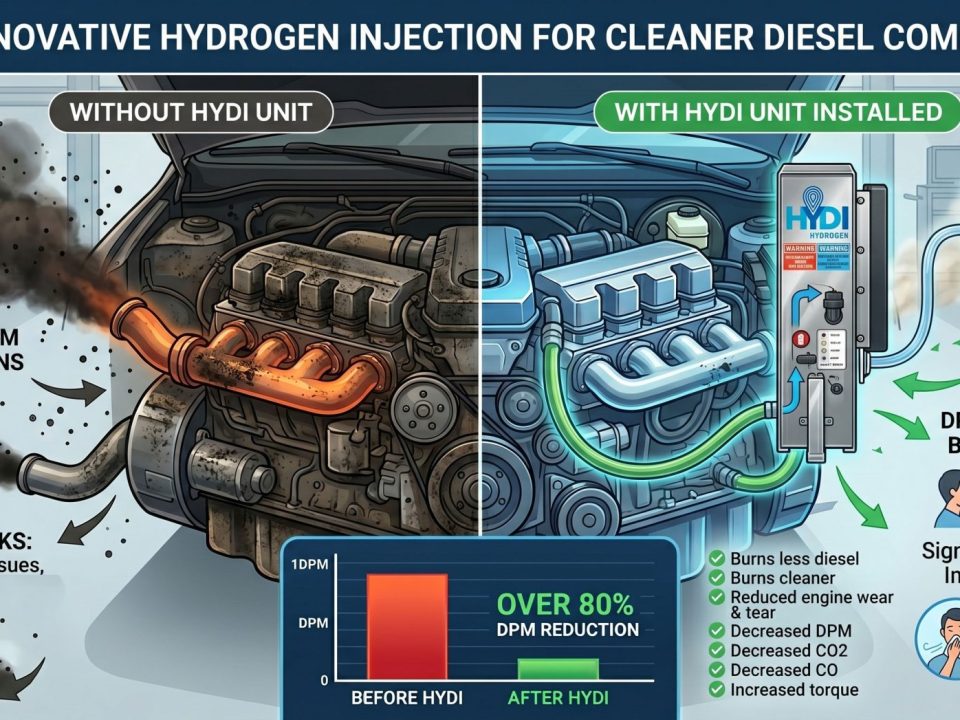
- 80% Reduction in DPM: Cleaner air at bus stops and transit hubs for passengers and pedestrians.
- Lower NOx & CO: Significant decreases in harmful gases that contribute to city smog.
- Visible Smoke Elimination: Enhances the public image of your fleet by eliminating exhaust soot.
Why HYDI for Public Transport?
Transitioning an entire fleet to electric or fuel-cell vehicles requires billions in infrastructure and years of planning. HYDI provides a “Net-Zero” bridge that can be implemented across an entire fleet in weeks.
- No Charging Infrastructure Required: HYDI units produce hydrogen on-board using distilled water. Buses remain on their standard routes and refuelling schedules.
- AdBlue Reduction: By optimizing combustion, HYDI reduces the stress on Euro 5 and Euro 6 emission control systems, lowering AdBlue consumption and maintenance costs.
- Proven Performance: Designed to handle the stop-start nature of city transit, providing torque when it’s needed most during heavy acceleration from stops.
- Seamless Integration: Compact units fit within existing engine bays of Mercedes, Volvo, Scania, and MAN bus chassis without compromising passenger capacity.
The Path to Sustainable Transit
Public transport authorities (PTAs) and private contractors can achieve immediate ESG milestones:
- Cost Savings: 5% to 14% fuel reduction directly offsets rising operational costs.
- Asset Longevity: Cleaner engines mean fewer carbon deposits, extending the life of current fleet assets.
- Community Health: Actively reduces the respiratory impact of diesel exhaust in high-density urban areas.
Modernise Your Fleet Today
Start your transition to a greener future without the infrastructure wait. Contact HYDI for a fleet-wide emission reduction strategy.
HYDI Hydrogen Direct Retrofitted to Diesel Metro Buses
HYDI have experienced unprecedented results when implementing HYDI systems in Adelaide Metro Buses.
Pre-trial fuel consumption:
| October | 40.5L/100km |
| November | 40.9L/100km |
| December | 43.7L/100km |
| AVERAGE | 41.7L/100km |
“set a new standard in Adelaide Metro Bus performance”
Trial fuel consumption:
| April 24 | installed |
| April 30 | 35.2L/100km |
| May 08 | 37.7L/100km |
| May 15 | 31.5/100km |
| May 29 | 35.7L/100km |
| June 05 | 36.1L/100km |
| AVERAGE | 35.2L/100km |
TEST 1 – Exhaust Emissions
| HYDI OFF | HYDI ON | VARIATION | |
| NO2 | 50 | 53 | -6.0% |
| NOx | 560 | 270 | 51.8% |
| NO | 511 | 217 | 57.5% |
| CO | 0 | 0 | 0 |
TEST 2 – Exhaust Emissions:
| HYDI OFF | HYDI ON | VARIATION | |
| NO2 | 71 | 19 | 73.2% |
| NOx | 477 | 374 | 21.6% |
| NO | 466 | 355 | 23.8% |
| CO | 12 | 5 | 58.3% |
Particulate Matter testing equipment not available.
Previous independent testing by University of SA on a generator recorded 80% reduction in PM emission.
“1560 performed surprisingly well throughout the day, the throttle response was much better than other buses, power from standing to desired speed was smooth and constant with little or no lag,
acceleration from any speed was quicker than most, held speed traversing Murrell Rd and McIntyre Rd with 5-8km/h loss. Overall very impressed with the performance of 1560. 1560 has set a new standard in Adelaide Metro Bus performance”.


Fast Facts
Hydrogen’s burn is complete, quick and clean, with nearly three times the energy output of diesel.
REDUCTION IN
CARBON MONOXIDE
UP TO
25%
REDUCED FUEL
USAGES
UP TO
14%
REDUCTION IN
PARTICULATES
UP TO
80%
REDUCTION IN SERVICE COSTS
DUE TO LONGER SERVICE INTERVALS
CLEANS
HEAVILY CARBONISED ENGINES