


Trialling Clean Energy for a Net-Zero Future
January 29, 2025Is Your Engine Bay Quietly Killing Your Workers? The Diesel Particulate Problem — and a South Australian Solution

If your business runs large diesel engines inside a workshop, depot, garage, or maintenance bay, there's a good chance your workers are breathing something they shouldn't be.
Diesel Particulate Matter — commonly known as DPM — is the invisible byproduct of every diesel engine cycle. It's a complex mixture of carbon particles, organic compounds, and trace metals that, when inhaled, embed themselves deep in lung tissue. The World Health Organisation classified diesel exhaust as a Group 1 carcinogen in 2012 — the same category as asbestos and tobacco smoke. Yet across Australia, thousands of workers in transport depots, emergency services stations, mining workshops, construction yards, and industrial facilities continue to be exposed to it daily, simply by doing their jobs. The question isn't whether your workers are being exposed.
The question is: what are you doing about it?
The Hidden Cost of DPM in the Workplace
For fleet-dependent organisations, the risks of diesel particulate exposure hit on multiple fronts:
Health and Safety Liability: DPM exposure is strongly associated with lung cancer, chronic obstructive pulmonary disease (COPD), cardiovascular disease, and respiratory inflammation. Workers exposed daily in enclosed engine bays — mechanics, operators, drivers, and yard staff — carry a significantly elevated lifetime risk. Beyond the human cost, this creates serious and growing workplace health and safety liability for employers.
Regulatory Pressure: Safe Work Australia continues to tighten exposure standards for diesel particulates. Organisations that rely on "it's always been this way" are finding themselves caught out by audits, compensation claims, and reputational damage.
Air Filtration Burden: In enclosed spaces, DPM rapidly overwhelms ventilation and filtration systems. The more particulate matter produced at the source, the harder — and more expensive — it is to manage the air quality downstream.
Vehicle Wear and Maintenance Costs: DPM is largely a symptom of incomplete combustion. That same inefficiency coats engine internals with soot, fouls oil, clogs filters, and shortens engine life. The engine isn't just polluting your air — it's slowly destroying itself.
A Proven, Practical Solution: HYDI Hydrogen on Demand
Developed right here in South Australia, HYDI (Hydrogen Direct Injection) is a retrofit technology that fundamentally changes the combustion equation in any diesel engine — without replacing the engine or the vehicle.
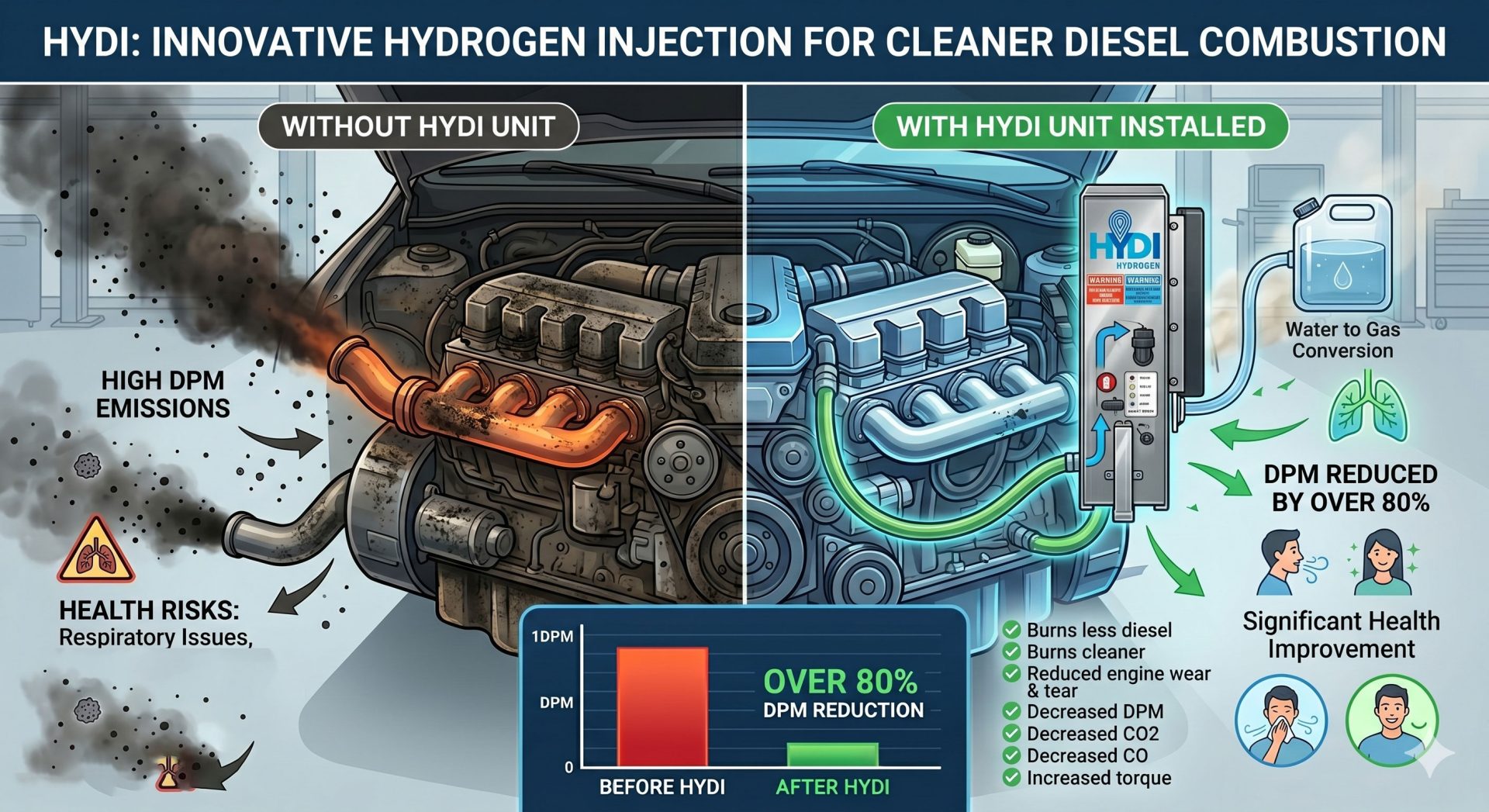
The concept is elegant in its simplicity. The HYDI unit uses the vehicle's own electrical system to split distilled water into hydrogen and oxygen gas through electrolysis. This hydrogen-rich gas is then introduced directly into the engine's air intake on demand, mixing with the diesel fuel to produce a significantly cleaner, more complete combustion event.
Critically, there is no high-pressure hydrogen storage onboard. Hydrogen is generated and consumed in real time — making it a safe, manageable solution for even the most demanding operational environments, including emergency services, mine sites, and heavy transport depots.
The Numbers: What the Holcim & Scania Trial Proved
This isn't theoretical. Large-scale real-world trials conducted with Holcim Australia and Scania have produced verified, independent results that are turning heads across Australia's fleet management and WHS communities:
|
Measure |
Result |
|---|---|
|
Diesel Particulate Matter (DPM) |
↓ 80% reduction |
|
Fuel Consumption |
↓ Up to 15% savings |
|
CO₂ Emissions |
↓ 17% reduction |
|
NOX Emissions |
↓ 22% reduction |
|
Carbon Monoxide |
↓ 25% reduction |
That 80% reduction in DPM is the headline figure for any organisation concerned about worker health. To put it plainly: if your engine bay currently exposes workers to a certain level of carcinogenic particulate matter, HYDI can reduce that source contamination by four-fifths — immediately upon installation.
The fuel savings figure deserves equal attention. A 15% reduction in diesel consumption across a heavy fleet is substantial. For organisations running dozens of large vehicles, this saving alone can fund the HYDI installation program, effectively making it a self-financing health and safety upgrade.
Beyond the Air: What Cleaner Combustion Does to Your Fleet
When combustion is more complete, less unburned carbon accumulates inside the engine. This has cascading benefits across your fleet's lifecycle:
- Extended oil service intervals — less soot contamination means oil stays cleaner, longer
- Longer filter life — both engine air and oil filters are less burdened
- Reduced engine wear — cleaner combustion means less carbon scrubbing cylinder walls and valve seats
- Lower total cost of ownership — across a heavy fleet, these savings compound significantly over the working life of each vehicle
For operations that run ageing diesel fleets where replacement isn't immediately feasible — construction companies, regional transport operators, emergency services, local government — HYDI offers a way to extend the productive life of existing assets while making them far safer to operate around.
Who Should Be Paying Attention?
If your operation fits any of these descriptions, HYDI warrants serious evaluation:
- Transport depots and logistics hubs where trucks idle and manoeuvre in enclosed loading bays
- Emergency services — fire, police, ambulance — with vehicles housed and started in closed stations
- Mining operations where diesel equipment operates in underground or semi-enclosed environments
- Construction and civil contractors running heavy plant through maintenance workshops
- Waste management and local government fleets maintained in depot garages
- Agriculture and irrigation with large diesel-powered pump stations or machinery sheds
- Marine operators running diesel engines in enclosed engine rooms
- Defence and defence contractors with large vehicle maintenance facilities
In every one of these environments, DPM accumulates. In every one of these environments, HYDI can dramatically reduce it.
The Regulatory and Insurance Landscape Is Shifting
WHS professionals and risk managers should be aware that the regulatory environment around diesel particulate exposure is tightening, not loosening. Safe Work Australia's Workplace Exposure Standards, combined with increasingly active workers' compensation claims linked to long-term DPM exposure, mean the cost of inaction is climbing every year.
Proactively implementing a demonstrably effective DPM reduction technology like HYDI is not just the right thing to do — it's increasingly the smart risk management decision. Documentation of active steps taken to reduce carcinogen exposure creates a meaningful record in the event of any future liability question.
South Australian Innovation, Nationally Available
It's worth noting that HYDI is a South Australian success story — developed, refined, and proven in this state before being deployed across Australia and internationally. For South Australian organisations in particular, backing this technology carries the added dimension of supporting local innovation that is genuinely competing on the world stage.
As Scania Australia observed following their trial, HYDI provides an affordable, immediate path for customers to reduce their carbon footprint and fuel burn across existing transport functions — without waiting for fleet electrification, without massive capital expenditure, and without disrupting operations.
The Bottom Line
Your workers' lungs are not a maintenance budget line item. But if a single retrofit technology can slash the carcinogenic particulate matter they breathe by 80%, pay for itself through fuel savings, and extend the life of your fleet — there are very few good arguments for not having the conversation.
HYDI is available now. It is proven in the field. And it is ready to be fitted to your fleet.
Contact HYDI today to find out how quickly your operation could be cleaner, healthier, and more cost-efficient.
HYDI Hydrogen Direct Injection is a South Australian developed and manufactured technology. Trial data sourced from Holcim Australia and Scania Australia field deployments.